Friday, September 11, 2015

Every 9/11 leads me back home to Tell City, Indiana

I was working in downtown Cincinnati at the Cigna offices on Seventh Street when my boss received a call from his dad in the New York office letting him know a plane had hit one of the World Trade Center towers. He shared this information with us, and we all assumed it was a small plane and the pilot had somehow lost control.
It was a splendid September morning in Cincinnati, just like it was in New York City: warm, sunny, clear blue skies. The weather was perfect. Soon that blue NYC sky would turn to dark gray then black.
We gathered in the kitchenette where a TV had been turned on and were stunned by what we saw: a gaping hole in the North Tower with fire spewing out of it. I was horror struck, and even more so as we witnessed the second plane, United 175, crash into the South Tower. The shock of it was chilling. We remained glued to the television and when American Airlines Flight 77 hit the Pentagon, I lost it, crying and wondering, 'what city would be next?'
I made my way back to my desk and called my sister Karen, who I knew would be home. She was working on her dissertation. I told her to turn on the television. As we were talking, she gasped and said, “Oh, my God. One of the towers just fell.” Shortly afterwards, we were all sent home. Even away from the chaos and fear, we felt it and didn’t know if we too might be next on the target list. I made it home just before Tower One crumbled, a sheet of ash and smoke cascading to the street.
I spent the next few days glued to the television. Somehow I felt that if I paid attention, sat vigil with the emergency workers, medical personnel, the people searching for loved ones, and New Yorkers trying to cope with the devastation to their city, that somehow I was offering them support, love, and strength. My sister nagged me to turn off the TV because my nonstop mourning was becoming unhealthy.
I thought that with the number of people affected by this tragedy that most Americans probably would know someone who worked in the World Trade Center or knew someone who did. Well, it ended up that I did know someone. Two people, actually: one who got out, another who did not. Her name was Stacey Peak. She graduated high school a year ahead of me. She was 36.


Stacey was from my hometown in southern Indiana and had been living in New York City for about two years, working at Cantor Fitzgerald as a gas/power stock broker. I heard the news from my mother. She told me that Stacey’s mother had received a call from her that morning. She was on the 105th floor of the North Tower when she made the call. Newspaper reports later revealed that her mother said Stacey was hysterical when she called, telling her that she was trapped and didn’t know if she’d be able to get out. She told her mother she loved her and then had to hang up.
I am forever haunted by that detail, wondering what those last moments of her life must have been like, the horror of rising flames and intensifying heat, knowing you were about to die. I know that is morbid, but it’s what I can never stop thinking about when I see photos of her lovely face and hear stories from friends and family. I also think of the helplessness her mother must have felt, not being able to protect her, save her. The anguish must have been intolerable and suffocating, as she waited for news of her daughter, holding out hope that somehow she escaped the carnage.
I did not know Stacey except casually, but the hometown connection, and discovering that she was single, never married, living life on her terms, taking acting classes, all of it somehow connected me to her. Sadly, her remains were never found. There is a memorial to her erected in our hometown, Tell City, Indiana, in Sunset Park by the Ohio River. Every year on September 11, the Perry County News highlights a story about her and local news stations in Evansville remember people from the area who perished that day as well.
Healing definitely takes time and the scars from that fateful day remain, the images and stories etched in our collective memory—for those of us who lived through it anyway. So as I do every year on this date, I will take a moment to remember Stacey as well as the other victims and their families, send a smile and a blessing heavenwards, say a prayer for her family and friends, and recommit to doing my best to try to make this world a better, more peaceful place. 


Thursday, September 10, 2015

Why Journal? (Tip/Reason #8)

Tip #8 – Journal writing generates ideas for articles or stories.

I’ve found that rereading past journal entries sparks ideas for articles or books. Take some time to peruse your writing and see how you might be able produce an article or story that will entertain or benefit others in some way, as I did with my journal of 2004 when I was going through cancer treatments, which became my book, a memoir, Rebirth


Recently, I included a letter I wrote to the Police Commissioner of Covington, Kentucky, back in 1999 in a political piece on police abuse of power. I was able to reproduce it and insert it as a PDF in the post because I had formatted it to fit my 1999 journal, printed it off, and taped it onto the pages—saved for posterity and (unbeknownst to me at that time) my political blogging sixteen years later. 

Explore your journals. You may find some gems in those pages that will ignite your creativity and/or advocacy and activism.  

Monday, August 31, 2015

Thanks for the inspiration, Dr. Dyer

Being creative means trusting your own purpose and having an attitude of unbending intent in your daily thoughts and activities. Staying creative means giving form to your personal intentions. A way to start giving them form is to literally put them in writing.  ~ Dr. Wayne W. Dyer, The Power of Intention


Dr. Wayne W. Dyer passed away Saturday, August 29, at the age of 75. His book The Power of Intention has been one of a handful of inspirational books I reread every couple of years.

I purchased this book in 2004 when I was going through leukemia treatment. At that time, I was trying to figure out what I wanted my post-cancer life to look like. Utilizing some of the techniques he describes I returned to acting, working in commercials and a couple independent films, wrote Rebirth, and started a journal writing workshop for cancer survivors, all within a six-year period.

Over the past few years, I have been going through a transitional period, finding myself uninterested in the pursuits that used to occupy my daily thoughts and actions. I have been moving in new directions—a passion for politics and travel, to name a couple—yet still not quite ready to relinquish my past goals and dreams.

It is time to pull out The Power of Intention again and read it—even if only the highlighted sections. It's time to get clear about what I want, to decide down which road I am heading. As always, my journal is the place I will turn to write about and imagine that future. As I've done before, I will write it down and make it happen.

Thank you, Dr. Dyer, for giving me tools and strategies to co-create my life, and yes, for the inspiration!

Friday, August 28, 2015

A Reader Asks: How do I make journaling a valuable part of my life? (Part II)

In Part I, I wrote about the importance of being truthful when writing, not censoring one's self. However, I also touched upon editing your writing, grammar and content, should you decide to publish all or part of your journal(s).

My email exchange with Marty also touched upon the audience for whom one writes. He shared with me:

You reminded me of something: the audience for my journals. When I write a journal entry, it's usually just for me, but also with an eye towards someone possibly picking them up and reading them. I remember one journal book (I have several completed) where I wrote on the inside cover something like "This journal is for Marty's eyes only, but if I'm dead, go ahead and read it. I won't care!" So there's always a lot of humor in them because in the back of my mind I have this weird expectation that someone is going to read them. Sometimes I'll write to make that mystery person laugh, or I'll deliberately put something in there to make myself laugh. It sounds conceited, and it probably is, but often I'll go back through my Facebook "Today in the Past" posts and find some silly status from five or more years ago that I'll have completely forgotten about, but it will just make me laugh. I guess that's what I do with my journals too, though I rarely reread them.

But the "mystery audience" is also a reason I will sometimes censor things, in the rare moments when my journals actually get that interesting. I'll really need to go back and read things to get a sense of what I leave out, because I think I'll be able to tell.

For those of us who consider ourselves writers, and maybe anyone who keeps a journal feels the same, it is natural to think of who may read our most personal thoughts, the struggles we are ashamed to share with anyone, or our darkest secrets. Will those readers be family and friends or strangers and what will be their reaction? Do we plan to publish parts or the entirety of our diaries? These are all considerations. 

It is tempting, when an audience is in the front of your mind, to be less than honest with yourself. I try to avoid censorship because I know that no one will read my journals—I live alone and they are stored on a shelf in my closet that the nieces and nephews are still too short to reach without a stool. Like Marty, my thinking is that once I'm dead, I won't care if anyone reads them. In fact, I like to believe that even the revelation of my negative qualities and experiences will serve to remind others that we are all human and quite fallible. We possess strength and weakness. We hide struggles and internal conflict from others, especially those closest to us. 

The downside is that someone you love may read a negative entry about themselves or some conflict that occurred with them that may not have found resolution. How will they respond to it? Hopefully, the relationship was strong enough that they understand the complexities of human interactions, misunderstandings, and hurtful behavior. I know I would, or like to think I would, be that understanding. Perhaps forgiveness, especially of one's self, can happen in this instance.

A while back, my nephew Andrew, who is now eleven, asked me if he could have my journals when I die. I laughed and told him probably not, at least not now at his young age. Upon further reflection, I am thinking maybe entrusting him with them at age twenty-five, should I no longer be on this earth then or thereafter. (I’d have to put those instructions in a will.) He was curious enough to ask, and it was flattering that he showed interest. He is curious, and I can imagine it would be thrilling to read my “secret” thoughts. (That makes me laugh, Marty.) Andrew has shown interest in writing a book, even at the tender age of nine, so bestowing my journal collection to his care is definitely something I am considering. 

Contemplating this and making a decision about it, leads me back to the audience. Even if I refrain from censoring the content, do I try to make it entertaining or provide some moral to the conflict or struggles with which I am dealing? In the end, I write for myself and make it compelling, even amusing, all while learning something from my experiences.


Nieces and nephews, Christmas 2012. This journal was a gift I received Christmas 2013 - Andrew is 2nd from the left. 

Marty returned to the idea of rereading one's journal at the end of our exchange: 

I stopped for a few minutes right before this paragraph and pulled out the journal that I keep in my bag. It's the most recent one I've worked on. The first entry is from March 8, 2009, right after Ryan came home from his 9 weeks in the NICU after his birth.The most recent entry is from Jan. 28, 2013, so I've been a bit out of the habit. But WOW! I did find this gem from March 10, 2009, when Ryan would have been home for about four days and was just over two months old:

"Yesterday afternoon I was sitting in the rocking chair holding Ryan just after a feeding. We were listening to a CD the choir gave us at the baby shower they threw for us on February 26. The song 'Puff the Magic Dragon' came on, which is a sad song anyway, but I was looking at Ryan's little face, his perfect little eyes shut in little slits as he slept in my arms, and I was overwhelmed by his innocence, the newness of his life, and the loss of innocence in the song. It could have also been the fatigue, or the reality of the past nine weeks finally setting in on me, but I began to cry for several minutes. The next song, 'Child of Mine' by Carole King, which has beautiful, tender lyrics, only made the crying worse. It was a nice moment though." Okay, THAT made rereading my journal worth it.
 

Yes, Marty, it is worth it. Your journal is a treasure trove of memories, wonderful and sometimes devastating. It is the story of you, and that is a gift you can leave to Ryan, should you decide to do so. Happy writing, my friend.


Related articles:

Tuesday, August 25, 2015

Why Journal? (Tip/reason #7)

Tip #7: Journal writing is a tool for self-expression and emotional release. 

Journal writing is a wonderful way to express one's emotions. Some people are comfortable verbalizing what they are feeling whereas others are more reticent about openly sharing feelings and thoughts. This is when journaling can be beneficial. It allows for the release of pent up emotions, positive or negative.


There are times when no one is available to talk to about a problem or share concerns and sorrow or fear. During my cancer treatment period, I often found myself alone and awake in the middle of the night, haunted by what-ifs and anxious about the future. My journal was where I turned, while others slept, to pour out all the unsettling thoughts and emotions building up inside of me. I always felt better after writing or typing about them.

Furthermore, because a journal is for your eyes only, you can be as brutally honest about what you are experiencing, and therein lies the value of putting pen to paper or fingers to keyboard: it is healing. Write it down and let it go.

Note: Journaling can be an effective self-therapy tool. However, it is no substitute for professional help should you need it.


Thursday, August 20, 2015

A Reader Asks: How do I make journaling a valuable part of my life? (Part I)

Recently I received a question, a couple actually, from my friend Marty about journaling. I admit I was honored that he would reach out to me for advice. I thought his question would make for an excellent blog post so I am reprinting what he wrote, with his permission. His questions, a follow-up email message, and my responses will comprise a two-part post.

Marty's questions: Every now and then I get the urge to journal. I may keep it up for a few days, but I always fall out of the habit. Most of the time my journal ends up being very humdrum "here's what I did today" with occasional bouts of philosophizing, but not much of that. My question is, do you go back and read through your old entries? Obviously you must because you wrote a book based on that concept. My trouble is that when I go back and read what I wrote years earlier, I can't stand the sound of my own "voice." More depressingly, I don't feel like I've changed at all. I know I have, but it's sad because I want to think I more mature, more enlightened. All of that is probably a subconscious reason I don't journal with any consistency. I think I journaled the entire first year of Ryan's [his son] life though. That might be a good one to go back and read. I'm not sure what I am asking you, but I guess it's this: How do I make journaling a valuable part of my life?


Response:  I understand your feelings, Marty. Similar questions came up frequently in the journaling workshops I conducted a few years ago.  

First, I reread journal entries all the time, many of which are cringe-worthy. However, by reading them I realize how much I've grown. Yes, there are persistent issues and patterns that seem to be stuck on repeat and those are the ones I resolve to keep working on, or eventually, end up accepting that it is just part of who I am and live with it. I believe acceptance is growth too, right, being aware there are parts of your personality that aren't going to change? 

Second, people assume keeping a journal requires they write every day and that the content must be important and literary. That is false. I go months sometimes without writing in my journal. In fact, I have barely written in my diary since returning from Europe on May 10, and most of what has been written is quite mundane. It is important to eliminate any judgment about the quality or quantity of your writing. 

Sometimes one doesn't feel like putting pen to paper or typing on a keyboard. Still, at these times I try to make myself write for at least three to five minutes. Often I end up writing for much longer periods and filling ten to twenty pages. At other times, there is nothing worthy to jot down, so I put the journal away. That's okay too.  

These journals are just for you, right? Of course, you would probably choose to do some editing should you decide to publish them. I did for Rebirth. There are many ways to journal aside from writing in a notebook. For instance, you have a social media presence. Reviewing past posts on Facebook is a great way to reflect on what is important in your life. Your posts are often funny and clever, which reveals that you have a wonderful sense of humor and that you use humor to make sense of this crazy world. That's valuable self-information and a terrific character trait and point of view to pass on to Ryan.

Furthermore, there is no one correct way to journal. It can be done on paper, the computer, a blog, via audio or video. I have been using my blogging lately in lieu of writing in a book because it is a form of journaling. I write about what is important to me, what is affecting the quality of my personal or professional life or my reaction to current events or politics.

I hope some of this is helpful. Find what works for you: frequency of writing, the form, and the content. I like to think I am decent writer, but when I reread my journals, often times they are not up to my standards either. That is because I am not writing for an audience. I am writing for me and so grammar, sentence structure, all of that goes out the window. Don't worry about that and more importantly, don't censor yourself. Write whatever comes to mind, even the ugly stuff. There are no set rules, except one (at least for me) and it bears repeating: don't censor yourself. 


I'll address writing for an audience in Part II, since my exchange with Marty touched on that as well. 

Related post:

Tuesday, August 18, 2015

Journal Writing Round-up: Three Articles


I am always searching for articles that outline the benefits of journal writing or ways to use journaling to improve one's life, career, or relationships. Recently, I came upon these three and provide a brief excerpt below the title. Click on the title to read the entire article. Enjoy.


Ditch perfection: "Your notebook is not meant to be a manuscript or memoir, but rather a place where you can "brain dump" ideas, organize your day and spark your creativity. It is not going to be a work of art archived in the Smithsonian, so don’t treat it as such."


Write in your journal. "No, not the “dear diary” kind of entries. Keeping a journal is a practice that can help you process the day and make sense of your thoughts. Keep your journal in the nightstand and every night take a few minutes to review the day’s triumphs and write down what you’re grateful for that day.

Don’t make this a boring, unthoughtful experience. Think of it as a nightly meditation -- just two minutes of reflection thinking about the day’s highlights and writing them down will transform your waking and sleeping thought. It’s part of a wealthy lifestyle to appreciate all the great things of the day: doors held open, great conversations had." 


""The act of writing is more powerful than people think," Peterson says.

Most people grapple at some time or another with free-floating anxiety that saps energy and increases stress. Through written reflection, you may realize that a certain unpleasant feeling ties back to, say, a difficult interaction with your mother. That type of insight, research has shown, can help locate, ground and ultimately resolve the emotion and the associated stress.

At the same time, "goal-setting theory" holds that writing down concrete, specific goals and strategies can help people overcome obstacles and achieve."

Thursday, August 13, 2015

Why Journal? (Tip/Reason #6)


Tip #6 - Research shows that expressive writing has health benefits.

Numerous studies have confirmed that expressive writing produces health benefits, such as a strengthened immune system, increased lung and liver function, increased cognitive function, reduced stress and blood pressure, improved mood, decreased symptoms of arthritis and asthma, and increased well-being in cancer survivors. Furthermore, it doesn’t matter if the writing topic is positive or negative. Healing benefits are derived as long as you involve the emotions. Therefore, journaling is a wonderful self-therapy tool, though not a substitute for professional help, if necessary.

You can read more about this in my Journaling through Cancer article in the March/April 2011 issue of Coping® with Cancer magazine.

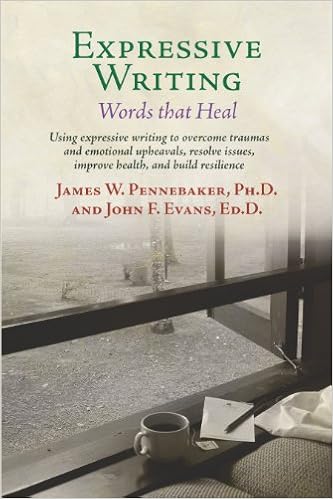
If you are interested in exploring this topic further, I recommend Expressive Writing: Words that Heal by James W. Pennebaker, PhD and John F. Evans, Ed.D.


Wednesday, August 05, 2015

5 reasons to journal (a recap)

I’m heading out on vacation this week and have little time to write so though I’d do a quick recap of the first 4 reasons to keep a journal and 1 tip. Click on the reason or tip to read more about each. Never fear, there will be more reasons to journal and many tips for doing so posted in the coming weeks.


  1. It's an easy way to record your life.
  2. It's a tool for working through life's challenges.
  3. Here's one strategy for tackling a problem.
  4. Use your journal to set and define goals.
  5. It's a safe place to express frustration and anger

Until next week, keep on writing, or start.


.


Friday, July 31, 2015

Write it Down, Make it Happen (Part II)

Read Part I

Ovation Theatre Company staged its first production on August 21, 1998. I and my fellow co-founders reveled in our accomplishment.

Opening night celebration at Arnolds
Fast forward to early 2000: I was managing director of Ovation and vice president of the newly-formed League of Cincinnati Theatres (LCT). LCT was formed in 1999 in large part due to the proliferation of small professional theatre companies like Ovation. The organization's mission: "to strengthen, nurture and promote Cincinnati's theatre community."

I was in an executive LCT meeting one day when the conversation turned to Cincinnati Playhouse in Park's upcoming season. They had slotted Talley's Folly in the spring of 2001. At that time, D. Lynn Meyers was the President of LCT and the producing artistic director (still is) of Ensemble Theatre of Cincinnati. She informed us that ETC was planning to jump on Playhouse's bandwagon and stage Wilson's Sense of Place during the same time period.

An idea ignited in my brain. I could hardly contain myself. Ovation needed to jump on that bandwagon too. This was my opportunity to perform a dream role I'd been writing about for years, but how could I persuade Ovation to stage Wilson's one-woman, one-act, The Moonshot Tape?

I brought this up at Ovation's next board meeting. We were in the process of planning the next season, so it was the perfect time to have this conversation. Joe, our artistic director, suggested we do a night of Lanford Wilson one-act plays. Unbeknownst to me—and seriously, how did I not know this?—Wilson had written dozens of one-acts.

We read through many and selected four, one of which was The Moonshot Tape. I immediately asked my Talley's Folly director, Mike, to work with me, as I'd told him I would in 1997. I was going to be onstage alone for fifty-five minutes. It was thrilling but I had no idea it would get even more exciting.

Two other small theatre companies decided they would also stage Lanford Wilson shows that May. There were now five companies producing Wilson's work, so it was decided to create a Lanford Wilson Theatre Festival, which generated a good deal of publicity for the smaller companies. To kick off the festival there was a reception at Cincinnati Playhouse. The guests of honor were Marshall Mason, a long-time collaborator of Mr. Wilson's, and Lanford Wilson. I met my favorite playwright. 'Pinch me,' I thought.
With Director, Michael Morehead and Landford Wilson
While talking to Marshall Mason, he asked what play Ovation was producing. I told him about the one-acts and that I was performing The Moonshot Tape. He told me that was one of Lanford's most personal pieces. Knowing that Ovation's opening wasn't until the following week and Mr. Wilson would be gone by then and unable to attend one of our shows, Marshall suggested Ovation host a private performance at our rehearsal space for him.

Thankfully, I was performance ready. I had worked on my character religiously over the past year, creating a biography for Diane, breaking the script down into beats, memorizing the end of the play and working back toward the beginning. I took copious notes and researched the time period and references in the play with which I was unfamiliar. I knew my character intimately and my lines were memorized by the time we began the eight-week rehearsal period, which is what my goal had been.

Mike picked up Mr. Wilson that Saturday morning and drove him to our rehearsal warehouse where I gave a private performance for a Pulitzer-Prize winner, my Ovation colleagues, and select friends. Lanford Wilson loved it. It was such an honor to perform for him and because he had praised my work so highly, it gave me the courage to finally commit, after ten years, to move to the New York City area to pursue a professional acting career.

I never imagined in my wildest dreams that performing Diane in The Moonshot Tape would lead to one of the most exciting, pivotal performance experiences of my life. Moreover, I was thirty-five when I played Diane, the same age as the character. I had also been thirty-one like Sally Talley in Talley's Folly. I felt like Lanford had written these women for me.

Receiving notes from Lanford Wilson post-performance
Can I say with 100% certainty that writing about these goals made them come true? No. However, without envisioning them, thinking about them, putting those wishes down on paper time after time and then taking action, they never would have happened. This is but one success story, composed of smaller ones, in my repertoire of how writing has shaped my life.

Think about any moments in your life that have manifest through your intentions. Did you spend time envisioning them? Did you write them down? If you cannot think of any examples or only a couple, I encourage you to test it for yourself, putting pen to paper or fingers to keyboard. It may take some time to see the results, so don't get frustrated. It took eight years to make performing The Moonshot Tape a reality. That only happened because of Ovation Theatre Company, meeting my Ovation co-founders through the Cincinnati community theatre scene, and being brave enough to go back to college to earn another degree in theatre and drama, all of which I wrote about extensively.

Write down your wishes and dreams, imagine what your life might look like, keep writing about it and be sure to inject your writing with passion—get your emotions involved. Be sure to follow this up with concrete actions. The outcome may be so much more incredible than you ever dreamed.


The examples I've provided in this two-part post demonstrate the power of imagination and writing, but action is also required. Work, even if only baby steps, is also necessary to propel you toward your goals and fulfill your potential. So, dear reader, what do you want to manifest?


Wednesday, July 29, 2015

Why Journal? (Tip/Reason #5)

Tip #5  - Take it out on your journal. It is the ideal place to vent your frustrations.

Sometimes one needs a place where they can safely express negative feelings. Rather than losing your cool at the office or with a loved one, which can easily escalate and lead to regret, retreat to your writing space at the first opportunity. There, lay it all out on the page or computer screen. I find venting is more effective when typing because I am better able to keep up with the thoughts racing through my head as opposed to handwriting them, which is considerably slower.

Allow all thoughts to appear on the page/screen. Do not censor them, just proceed with this task until you cannot, or do not, want to write any more. I guarantee you will feel a huge release from any pent-up negative energy. Do not read this entry immediately, if ever. Allow it to sit. Wait a few days if you do decide to review what you wrote. You can also choose to get rid of it. There are no rules.


If after a few days you are still stewing over whatever happened that incited your anger, take some time to read through the entry, if you still have it. Are there any solutions?  Do you feel the need for additional angry writing? If so, go at it. I repeat this exercise two more times if there is a situation over which I am obsessing.

However, if you fail to find peace or resolution, you may need to talk it out with the offending person. If you cannot directly speak with that person, perhaps a trusted friend or a professional can provide some guidance that will lead to relief.

Anger is stressful. I've found writing out my anger to be an effective way to not only alleviate it, but also to find solutions for dealing with whomever or whatever has upset me, or at least resolve to get over it. The next time you want to strike out at someone, take it out on your journal first.


Thursday, July 23, 2015

Write it Down, Make it Happen (Part I)

I sat in the silent warehouse, breathing in and out, following the rise and fall of my breath and trying to ignore my racing heart. It was a Saturday morning. My shaking foot belied the serenity I hoped to convey to anyone watching, knowing that soon I'd be giving—what I imagined to be—the performance of my life. It was still unbelievable to me that an event at the beginning of the week presented this opportunity; that something wished for years earlier could manifest in such an extraordinary way. This outcome was so much more incredible than I ever could have imagined: I had thought about it, written about it, but had no idea how it would all unfold.

I can attest to the value and power of the written word as someone who has been journal writing for twenty-three years. Not only have I written for my life during times of crisis, but I have actually written my life, which is exciting and empowering—knowing that I am the creator of my life.There are numerous examples in my writings to support this assertion. The above experience contains several layers of manifestation that culminated in one extraordinary outcome.

I always wanted to be an actor. My best friend, Lynn, who is a bigger pack rat than I, sent to me when I was going through cancer treatment a list that our fifth-grade teacher had compiled. All her students' names were on it and next to each name was the occupation we wanted to be as adults. Next to my name was the word "actress." I hadn't done any acting in grade school or high school, but I mustered the courage and returned to college to study drama at the age of twenty-three.

During that time, I auditioned for all the theatre department's plays. One play (of many) in which I failed to get cast was Talley's Folly, a two-person show by the late Lanford Wilson. I fell in love with the character of Sally Talley and knew I had to portray that character someday. Exposure to this play turned me into an admirer of Lanford Wilson's work, reading nearly every play he wrote, or so I thought.

I began keeping a journal in 1992 and would write about roles I was exploring in class or in a play. Lists of shows and characters I longed to perform were recorded in my diaries too. One day, I came across a show by Lanford Wilson titled The Moonshot Tape that was in an anthology of one-act plays. This one-act was a solo project, and I was immediately drawn to Diane, a deeply flawed yet fascinating character. Diane is thirty-five years old, an accomplished short-story writer, and possesses a rather sordid, complicated past. Here was another role I committed to one day performing, not having a clue how, when, or where it would happen. I was twenty-seven at the time and had also been contemplating starting my own theatre company upon obtaining my drama degree. All of these goals were written about in my journals.

I ended up in Cincinnati, Ohio, after graduation, initially getting involved in that city's vibrant and massive community theatre scene as both an actor and director. While directing The Diary of Anne Frank, I met Lisa, a talented actress whom I'd cast as Mrs. Frank. We began discussing starting our own semi-professional company. I did research, constructed a business plan, and wrote about this endeavor constantly in my journal. In the end, it seemed like too monumental a task for two people; it started to overwhelm me. Plus I longed to focus solely on acting.

We put that venture aside and  both continued performing. Not long after, Lisa was cast in a community theatre production of The Secret Garden where she met Joe, Mark, and Scott who too had the desire to start a professional theatre company. They approached her to see if she might be interested in joining them. To which she responded: There is someone you need to meet. We did and soon Ovation Theatre Company was on its way to becoming a reality.

With Ed Cohen (Matt Friedman) in Talley's Folly
The next year was spent planning, budgeting, fundraising, and on July 4, 1997, we signed Ovation's incorporation papers, filing as a 501(c)(3) organization. During this preparatory period, I was cast in the role of—you guessed it, maybe—Sally Talley. Finally, here was the chance to perform one of my dream roles. Sally is thirty-one and I was thirty-one when I portrayed her. Mike, the director, was fantastic and because I enjoyed working with him so much, I gave him a copy of The Moonshot Tape and told him that if I ever performed this role, I wanted him to direct me.

In September 1998, Ovation staged its inaugural production, the two-woman comedy, Parallel Lives: The Kathy and Mo Show. Lisa and I starred in it. We directed it too, along with one of our co-founders Scott. It was thrilling. Another dream had come true. To reiterate, these were all goals and hopes I'd written about either in my journal or strategized about in lists on separate pieces of paper. I was constantly writing, thinking, and putting those ideas into action. However, the best was yet to come...

With Ovation co-founder and co-star, Lisa Hall Breithaupt, on opening night of Parallel Lives

What goals or dreams have you written about that have manifest in your life? Please let me know in the comments or email me at deborah@deborahludwig.com. I may use them in a future post, with your permission of course.


Wednesday, July 22, 2015

Why Journal? (Tip/Reason #4)

This site is about how journaling and expressive writing can be tools for bettering your life. A series of weekly tips will be posted as of July 1. The first several are reasons—rather than tips—to consider starting a journal. However, for consistency, these reasons will be categorized as tips.


Tip #4 - Why Journal? 

It’s a great tool for setting and achieving goals. The mere act of writing down your goals increases your chance of success.

Write down your goals, make them SMART (specific, measurable, attainable, realistic, and timely), commit to them, and hold yourself accountable by reporting weekly, or at least monthly, your progress to someone who supports your efforts.

There is much more to write on this topic and I will do so in the future. For now, below are some related articles you may find helpful and interesting.

Friday, July 17, 2015

Journaling Tip #3...Related to Tip #2 (working through challenges)

Journal writing as a tool for working through challenges was journaling Tip #2 posted on July 8. Today's tip expands on that.

One strategy for solving a problem is to write your challenge or issue down in your diary at night. Include the solutions you've already considered. Now, go to sleep and allow the unconscious mind to work. In the morning, before you start your day, pick up the journal and start writing about your situation and see if any new solutions have presented themselves overnight.

If no new ideas have appeared, try this exercise every night—or as often as you are able—for a week. If after a week, you still haven't discovered new strategies, it could be time to reach out for assistance, be it from an expert, a colleague, or a friend. However, give it a try. The unconscious mind works in mysterious ways.


Related article - Got a big decision to make? Sleep on It:

"We tend to consider the time we spend sleeping, for instance, as a mentally inactive period. But sleep is associated with better memory performance, and "slow-wave" sleep in particular has been shown to enhance our ability to make mental connections and integrate unassociated information. 

This sort of mental heavy-lifting during sleep could be useful for discovering creative solutions to problems and could potentially help combining factors in a way that allows us to make decisions." 

Wednesday, July 15, 2015

The Value of Rereading Your Journals: Remembering Treasured Moments

When I visit my hometown in southern Indiana to celebrate the Christmas holiday with my family, my mother and I take a day, just the two of us, to drive to Evansville to do some last-minute Christmas shopping and have lunch. It is a day I treasure and one that I make sure happens. This has been our holiday tradition since 2004 when I was still recovering, though mostly healed, from my June 1 bone marrow transplant.

I had forgotten the date this yearly outing began until I came across the brief December 15, 2004, journal entry while reorganizing my manuscript for the second edition of Rebirth. The entry provides no details of our interactions or conversations. However, it transported me back to that day, searching for the perfect present for my (then) almost-two-years-old nephew Aidan.


December 15, Wednesday:

Mom and I went Christmas shopping in Evansville yesterday. I found a Hokey Pokey Elmo and a play Home Depot drill at Toys "R" Us for Aidan. The drill comes with screws, bits, and a small plastic board in which Aidan can drill the screws. All the pieces are over-sized. The toy is designed for kids ages three and above, but Aidan loves toys that are similar to adult items, especially tools and phones. I think he'll really like these gifts. 


'What a difference a year makes,' I thought after reading it. Christmas 2003 was scary and sad because I was diagnosed with leukemia on December 18 and chemotherapy commenced at 8:00 pm on Christmas Eve, so Christmas 2004 was a true celebration. I was healthy again. Joy, not fear, was the state in which I resided. Shopping, having lunch, and talking—about whatever—with my mother was wonderful; so wonderful that I have made sure that experience has been recreated every year since.This one-on-one time with her is special. I cherish it. It's our time to reconnect.

One reason to keep a journal is to preserve moments. An event or person you may not have thought about in years can be rediscovered by rereading your journals. That may not always make one comfortable, depending on the event or person, but it always provides an opportunity for reflection and self-examination. Rereading journals, or only select entries, provides the writer with information from her past that may prove helpful in the present or the future.

Should you come across entries that are inspiring or bring a smile to your face, mark those pages with a paper clip or a small post-it. This way when you are feeling down or going through a difficult time, you can immediately find these positive entries. They will remind you that life is good, they may improve your mood—even if only for a little while, and they may provide encouragement to make the changes necessary to transcend the situation or feelings with which you are struggling.

Take some time to explore old journals. You may be surprised and delighted by the discoveries you uncover in the pages.


Do you reread your journals? If so, what memories have resurfaced for you? Were they positive or negative and how did you feel revisiting them? I'd like to know your thoughts. Please leave a comment below or email me at deborah@deborahludwig.com. I may use your response in a future post, so let me know if I have permission to reprint it. Thanks!

Friday, July 10, 2015

Protecting Your Journals' Content

Phillip Seymour Hoffman's death on February 2, 2014, at the age of forty-six saddened me for several reasons. One, being an actor, I always feel a sense of loss when a young, talented performer exits this world, especially when it is a self-imposed exit, be it accidental or intentional death. Two, as someone who has fought my own demons, I empathize with someone struggling to overcome addiction. Three, as a long-time diarist, it was disturbing that some details in Mr. Hoffman's private diaries were made public.


Some of what I read included:

His diaries did not include suicidal thoughts or chronicles of drug activity, according to sources who saw them, though the entries did provide insight into the actor's state of mind. The private journals contained musings about his struggles with addiction, as well as thoughts that were tough to decipher.

...and this:

Writing in his private diaries, the 46-year-old Hollywood star talked about feeling 'caught in between' long-time girlfriend Mimi O'Donnell and another woman he had recently met. Hoffman's journal entries suggested that his relationship with his unidentified new paramour may have triggered his split from O'Donnell, who asked him to move out of their Manhattan home three months before his death.

In his often incoherent 'secret diaries,' Hoffman had described being troubled by 'demons,' wrote about drug deals, and his struggle to overcome his addiction with Narcotics Anonymous meetings".


I understand the public's curiosity surrounding the actor's death, especially the sordid details. I also know that the authorities used this information to shed light on the investigation. While the exposure of his writings seems to have been minimal, for anyone to reveal portions of his diaries for public consumption infringes on his privacy; these are his personal musings. Yes, he's dead and he was a celebrity, but even dead celebrities—and their families—deserve some degree of privacy. This situation prompted me to consider the security of my own journals.


Twenty-three years of journal writing have helped me transcend challenges and achieve goals. These journals are repositories for life events, a chronicle of my time on this planet. While there are many positive and inspirational entries, there are also dark ones that contain information that I prefer remain secret.

When one keeps a record of her life, how to keep those records from prying eyes is an important decision. It is also critical that there be instructions upon one's death for the disposal, storage, or transfer to someone else's possession of these diaries. Some questions to ask yourself are:

  1. Do I want anyone else to read them? If yes, who?
  2. Do I want them destroyed? If yes, how and by whom?
  3. Do I want them stored and made available for research or publication? If yes, where would the storage facility be located and what would the timing be for publication (5 years, 10 years, etc.)?
  4. Do I plan to pass them on to a family member or friend? Who?
  5. Do I want any of them published? Who would be appointed to do that? (Note: If you think you may publish your journals, start editing them yourself now or select an editor to do it upon your death. This way the task won't fall to a family member or friend.) 

Consider all these issues and include the instructions in your will. The last thing we want is for our most intimate thoughts and struggles to be broadcast to the world without our permission. What is shared publicly should be dictated by our wishes, not haphazardly released by the media, police, family or friends, no matter how well-meaning their intentions. This is your life story and how you decide to share it should remain in your hands alone.

It's time for me to make these plans; I have yet to do so. I'll let you know what they are once completed as a follow-up to this piece. If you haven't made provisions for your journals yet, I encourage you to do so. If you have made plans for securing your journals, please share them in the comments. You may help me or other diarists decide what actions to take.

Good luck!


Wednesday, July 08, 2015

Why Journal? (Tip/Reason #2)

This site is about how journaling and expressive writing can be tools for bettering your life. A series of weekly tips will be posted as of July 1. The first several are reasons—rather than tips—to consider starting a journal. However, for consistency, these reasons will be categorized as tips.

Image from Clipart Pal


Tip #2 - Why Journal? 

Journal writing is an excellent way to work through life's challenges. We all encounter obstacles. Writing is a useful tool for understanding those challenges and figuring out strategies to overcome them or deal with them more effectively. Some challenges require more time and effort than others but by putting pen to paper or fingers to the keyboard, you will have concrete ideas in front of you that can be put into action as opposed to merely ruminating over them in your head. You are less likely to forget strategies and plans when you write them down. Plus there is a record of your thoughts, which you can revisit as the need arises.

Write about it, put a strategy in place, review it, and take action.

What challenges has journal writing helped you overcome or deal with more effortlessly? Please share in the comments.

Wednesday, July 01, 2015

Why Journal? (Tip/Reason #1)

This site is about how journaling and expressive writing can be tools for bettering your life. Starting today, a series of weekly tips will be posted. The first several are reasons—rather than tips—to consider starting a journal. However, for consistency, these reasons will be categorized as tips.


Tip #1 – Why Journal?

It is a terrific way to chronicle your life—the ups and downs, triumphs and challenges, milestones and every-day occurrences, interactions with family, friends, and colleagues, as well as all the interests and ideas that comprise your unique existence. It also provides information about the time period in which you reside. Your journal is a legacy, a gift of insights, knowledge, musings, inspiration, and historical context, that you can bestow to future generations, should you be so inclined.  

Monday, June 29, 2015

Sylvia and Me - June 1992

I became acquainted with Sylvia Plath in the spring of 1992 when I was cast in the play Letters Home, based on the book Letters Home, which is a compilation of the letters Sylvia wrote to her mother, Aurelia, from the time she entered Smith College in 1952 until her suicide in 1963. No, I was not cast as Sylvia, but rather at the ripe old age of twenty-six, her sixty-seven-year-old mother. Still, I was up to the challenge and very excited to have the opportunity to perform in my first two-person show.

In addition to studying the script, I read the book, but I still wanted to learn as much about Sylvia’s life as possible in order to play her mother more convincingly. I visited libraries and bookstores seeking additional material on both women, but the jewel of my biographical treasure hunt was a small paperback titled The Journals of Sylvia Plath. I was riveted by her writing, the way she utilized language to record events and feelings, her desires and dislikes, the obsession about her talent as a writer and her career. Reading this book inspired me to start my own journal and use it to develop my character so that I would embody Aurelia Schober Plath by opening night.
I ventured to the bookstore once again and found the area where journals were displayed. My goal was to select the perfect one to commence my writing adventure, and it didn’t take long to find it. I had taken several art history courses in college and was particularly fond of styles popular in Europe and Russia from around 1850 through the 1940s, so when I spotted a journal with George Seurat’s masterpiece Sunday Afternoon on the Island of La Grande Jatte, I knew it was to be mine. The pages were unlined and a white cloth marker was attached so that I could easily mark where the next entry should start.
I immediately put pen to paper once home. Here is an excerpt from that initial journal post:
June 9 – Tuesday:
I bought this gorgeous journal today. I love the cover: Seurat’s pointillism technique is fascinating…
Since I’ve been studying Sylvia Plath’s life—reading her letters, poetry, and journals, the desire to record feelings and events in my own life has become very intense. Today, I decided after the play is over, I’m going to contact some agencies in Indianapolis and see if I can get an agent and some commercial work. I’ve got to do something to earn more money and what better way to do it than by acting—what I love to do—and gain some experience at the same time.
Reading Sylvia’s journals and letters, my writing seems so amateurish and trite. The way she expresses herself and the eloquent language she uses—impeccably structured sentences and an extensive vocabulary—sparks a bit of jealousy because I’ve always thought writing a story, play, or novel would be so gratifying.
Doing this play has me totally consumed with knowing Sylvia, even though I play her mother, Aurelia. However, what better way to portray a mother than knowing her daughter intimately, and how the daughter feels about the mother, whether positive or negative. Sylvia’s life was fascinating (so was Aurelia’s), and I feel extremely fortunate to have been given this opportunity. Tomorrow I start memorizing Act II. Laura [director] says tomorrow in rehearsal we’re going to solidify Act I blocking then Thursday, start blocking Act II.
My first journal
Throughout that rehearsal period, I recorded thoughts about my character and her relationship to her daughter, explored the actions, reactions, tactics, and objectives Aurelia (I) would use, and created a detailed biography—all those wonderful explorations actors undertake in fleshing out their characters to make them believable and interesting. Through rehearsals and opening night until closing, I continued to write about my character, my performance, and the audiences—documenting the nuances of the entire experience. I felt a genuine sense of fulfillment and pride taking on that role and stretching my acting capabilities. Furthermore, I am glad that time period and that accomplishment are captured in a journal because those entries reveal how much I have grown over the years both as a professional and a person.
Writing in my journal eventually became a habit, though not necessarily a daily one. I can go weeks without writing a word, then at other times an all-consuming event or problem holds my attention and I write daily, even multiple times a day. It is an integral part of my life, and the journey continues. Thank you, Sylvia, for the inspiration.

Please let me know in the comments: Why did you begin journal writing? What did your first journal look like?