Showing posts with label expressive writing. Show all posts

Tuesday, May 31, 2016

Why I chose to burn my journals

By Lisa Leistner Hammack

I began journaling in 2004. Before then, I had made several attempts to keep a journal. Even as a young girl, I tried doing it, to no avail. What made me, at the age of forty-three, start journaling and keep going I don’t really know. Perhaps writing my first poem ignited the initial spark.  
 
I possessed a variety of journals. There were large ones and small ones; some held colored pages and some plain white ones. Bold images adorned the covers of many while inspiring phrases were etched on the outside of others. I purchased them from different retail outlets: Barnes & Noble, Wal-Mart, Books-A-Million, monastery gift shops, etc. 

In the journals, I wrote poetry, recorded quotes, and took notes from books I was reading that I wanted to remember. I wrote about my days, jotted down information I learned from workshops and conferences, explored my perception of words said or actions taken by myself or others, stapled interesting magazine articles and paper-clipped notes from others onto the pages. Mainly though my journals were for prayers. I find it easier to pray when I write. I thought it was pretty cool that the main character, Aibileen, in Kathryn Stockett’s “The Help” also wrote her prayers.

By 2014, I had accumulated many journals. If I finished one and didn’t have another to start, which rarely occurred, I felt lost. Later that year, the urge to downsize came over me because I was ready to move from our big home to an apartment. It was hard work, sorting through all of our belongings and fitting all my clothes into one closet and one chest of drawers. Of the four large storage areas in our upstairs all but one are completely empty; the one that is not, is only half full. I secured all my journals in a large plastic tote and put them in the storage area, but something about their presence kept nagging at me.   

I began to seriously consider if I wanted to keep them for my family to read. More importantly, did I really, truly want anyone to read them? I contemplated this for months, repeatedly going back and forth between the desire to keep or destroy them. Then one day my decision was clear: I did not want anyone reading my journals. Some things are best left between me and God. Furthermore, I was concerned that people would misconstrue what was written throughout those pages. The decision: They were to be burned.

I live in a small town, which has burning ordinances. Aside from the environmental rules and although we have a small fire pit, I knew it was sorely insufficient for my needs, so I called upon some friends. They reside in the country and have a large fire pit, so my husband and I packed up food for grilling and visited them one evening. We sat around the fire pit, grilled food, ate, and the journal burning commenced. I thought I might feel regret taking that action, but instead I felt a sense of freedom. 

Their five-year-old granddaughter was visiting during some of the journal burning. She would pick up a journal, pretend to read it then ask if she could throw it into the fire. When she came upon those with beautiful images on the covers she would ask me, “Are you sure you want to burn it?” Eventually, she asked me why I was burning them.

I told her, “I just do not want them anymore, and I don’t want anyone else to read them.” That answer satisfied her. 

Finally, there was one journal left. I had bought it at a monastery. It was diminutive with a blue vinyl-type cover—I don’t recall the words on it—and gold-edged pages. I had saved this one for last because I thought burning that particular material might stink. The little girl held onto to it for a long time, looking at the cover and touching the gold-trimmed pages. She asked me if she could keep this one. I told her, “No honey, they all need to be burned.” She sighed, said okay, and tossed it into the flames. 

It took three and one-half hours to burn them all in that large fire pit. I wondered if I would have regrets as I watched them disintegrate into the flames. It has been close to a year now, and I can honestly say: I have no regrets. I did keep copies of my poetry though.

I wondered too if I would buy another journal. I haven’t and instead decided to use a one-inch binder and loose-leaf paper for any journaling. That way I can shred the pages when I feel the need. As stated previously, there are some things that need to stay between me and God. I’m okay with that.

Friday, May 06, 2016

Writing Life is Back

Writing Life is back! After a five-month hiatus, we are ready to start sharing content again. I had been working on a project, with multiple components, that I had planned to launch this year. Sadly, the timing for it is not quite right and has proven to be more than I can accomplish alone. While I have not abandoned it, it has been put on hold indefinitely.

I know, I know, everything doesn't have to be perfect, but for me, the product must be as polished and professional as possible plus it demands unwavering commitment because of the daily writing, producing, and posting of content required. That level of commitment is lacking right now. So, I am focusing on other things such as travel in September, a healthier lifestyle, spending more time with family and friends, learning foreign languages, studying current events, history, and feminism, and in general, just having more fun.


I also reach a milestone tomorrow: I turn fifty. My intention this year, for some of this blog, is to post "This is 50" segments. Each stage of our life is different, and I always feel youthful regardless of the passing years. My experience being fifty is/will be different than yours, but I want to share mine with you. Those of you fifty and older, feel free to send to me your stories and experiences. They may end up in a blog at some point. Those younger than fifty, I'd enjoy hearing your stories too about aging, whether it's turning thirty or forty or merely another year older. What have you learned over the years? What do you struggle with, physically or emotionally? Whatever it is you would like to share, feel free. You may contact me at deborah@deborahludwig.com.

I am excited to enter this next decade. Many women dread getting older, but after having been diagnosed with leukemia when I was thirty-seven, I look forward to each birthday. It is a celebration because as we know, many people do not make it to old age, and I would like to be one of them who does.

I look forward to sharing interesting, useful, and sometimes provocative content with you. Until the next time, here are a few previous posts you may find interesting, or browse through older posts where you will also find journal writing tips.


Journaling Through Cancer in the 21st Century

Appreciate the present and leap into the future by reflecting on the past

Is Blogging Journaling?

Write it Down, Make it Happen (Part II)

Protecting Your Journals' Content


Have a happy Mother's Day weekend!

Thursday, November 05, 2015

Journaling through Cancer in the 21st Century

My article is in Coping® with Cancer magazine and on the website as a featured article and the lead one on the Wellness/Emotional Well-being landing page. Enjoy!

Journaling through Cancer in the 21st Century


Friday, September 25, 2015

Why Journal? (Tip/Reason #10)

Tip #10 – Journal writing is a way to hone and practice your writing skills, expand your creativity, and play. 

Journal writing is a way to test out a short story, article, or poem you are trying to craft. It is a place to jot down ideas and play with phrasing. Don’t be afraid to strike out words and try others in their place. Make a mess of the page–out of the chaos you may produce some literary gems.

If you prefer a more visual medium, draw or paint in your journal. One of my workshop participants drew a gorgeous image using pens of vibrant shades of yellow, green, purple, red, pink, and blue to express a situation with which she’d been struggling. Painting, coloring, creating a collage or even scrapbooking are all forms of journaling to consider. Allow yourself the freedom to experiment with different colors, visual image techniques, and writing styles.  

When I was going through cancer, I was given several decks of inspiration cards and regularly wrote my interpretation of the sayings and why they resonated with me. I bought colored construction paper, made small rectangular cut-outs, and glued them into my journal to create pouches in which the cards were placed, and decorated the pouches with stickers. This was a way to add variety to my journal pages and make them aesthetically appealing. Furthermore, it was enjoyable.  


Journaling is not only about the written word. Have fun, express yourself, and be creative!


Tuesday, September 15, 2015

Why Journal? (Tip/Reason #9)


Tip #9 - Journal writing is a way to better understand yourself. 

Self-exploration requires digging into past events, relationships, and emotions. When you go back and read your journals, you see patterns in your life—some beneficial and others detrimental. If you can recognize negative patterns, you are then able to make the required changes—that is if you are ready to do so. Self awareness can move you in a positive direction, making adjustments so that you avoid the same hurdles you've repeatedly jumped over in previous years. This provides an understanding of why you behave the way you do or why you keep using the same strategies and expecting different results. (Didn't someone say that is the definition of insanity?) 

Writing helps you process emotions and the why for making decisions. Understanding the why associated with your emotions and behaviors and recognizing patterns can potentially free you from insanity, so get sane! Search for the negative patterns that persist then resolve to make the needed correction(s). Write out a plan and follow it. Good luck.


Writing Exercise:

Think of one moment in your life or a person who may have been instrumental, purposely or not, in changing how you felt about yourself, the path you chose, or a decision you made. 
  1. What changed in how you felt about yourself and why?
  2. Why did you make the choice to go down that particular path? Were there other alternatives you had considered?
  3. Do you have any regrets? Why or why not?
  4. Can you imagine what your life may have been like if you had chose differently? Is that even a question worth considering?


Please email me at deborah@deborahludwig.com or leave a comment should you wish to share any of your writing with me. I may use it in a future post, with permission of course.  

Tuesday, August 25, 2015

Why Journal? (Tip/reason #7)

Tip #7: Journal writing is a tool for self-expression and emotional release. 

Journal writing is a wonderful way to express one's emotions. Some people are comfortable verbalizing what they are feeling whereas others are more reticent about openly sharing feelings and thoughts. This is when journaling can be beneficial. It allows for the release of pent up emotions, positive or negative.


There are times when no one is available to talk to about a problem or share concerns and sorrow or fear. During my cancer treatment period, I often found myself alone and awake in the middle of the night, haunted by what-ifs and anxious about the future. My journal was where I turned, while others slept, to pour out all the unsettling thoughts and emotions building up inside of me. I always felt better after writing or typing about them.

Furthermore, because a journal is for your eyes only, you can be as brutally honest about what you are experiencing, and therein lies the value of putting pen to paper or fingers to keyboard: it is healing. Write it down and let it go.

Note: Journaling can be an effective self-therapy tool. However, it is no substitute for professional help should you need it.


Thursday, August 20, 2015

A Reader Asks: How do I make journaling a valuable part of my life? (Part I)

Recently I received a question, a couple actually, from my friend Marty about journaling. I admit I was honored that he would reach out to me for advice. I thought his question would make for an excellent blog post so I am reprinting what he wrote, with his permission. His questions, a follow-up email message, and my responses will comprise a two-part post.

Marty's questions: Every now and then I get the urge to journal. I may keep it up for a few days, but I always fall out of the habit. Most of the time my journal ends up being very humdrum "here's what I did today" with occasional bouts of philosophizing, but not much of that. My question is, do you go back and read through your old entries? Obviously you must because you wrote a book based on that concept. My trouble is that when I go back and read what I wrote years earlier, I can't stand the sound of my own "voice." More depressingly, I don't feel like I've changed at all. I know I have, but it's sad because I want to think I more mature, more enlightened. All of that is probably a subconscious reason I don't journal with any consistency. I think I journaled the entire first year of Ryan's [his son] life though. That might be a good one to go back and read. I'm not sure what I am asking you, but I guess it's this: How do I make journaling a valuable part of my life?


Response:  I understand your feelings, Marty. Similar questions came up frequently in the journaling workshops I conducted a few years ago.  

First, I reread journal entries all the time, many of which are cringe-worthy. However, by reading them I realize how much I've grown. Yes, there are persistent issues and patterns that seem to be stuck on repeat and those are the ones I resolve to keep working on, or eventually, end up accepting that it is just part of who I am and live with it. I believe acceptance is growth too, right, being aware there are parts of your personality that aren't going to change? 

Second, people assume keeping a journal requires they write every day and that the content must be important and literary. That is false. I go months sometimes without writing in my journal. In fact, I have barely written in my diary since returning from Europe on May 10, and most of what has been written is quite mundane. It is important to eliminate any judgment about the quality or quantity of your writing. 

Sometimes one doesn't feel like putting pen to paper or typing on a keyboard. Still, at these times I try to make myself write for at least three to five minutes. Often I end up writing for much longer periods and filling ten to twenty pages. At other times, there is nothing worthy to jot down, so I put the journal away. That's okay too.  

These journals are just for you, right? Of course, you would probably choose to do some editing should you decide to publish them. I did for Rebirth. There are many ways to journal aside from writing in a notebook. For instance, you have a social media presence. Reviewing past posts on Facebook is a great way to reflect on what is important in your life. Your posts are often funny and clever, which reveals that you have a wonderful sense of humor and that you use humor to make sense of this crazy world. That's valuable self-information and a terrific character trait and point of view to pass on to Ryan.

Furthermore, there is no one correct way to journal. It can be done on paper, the computer, a blog, via audio or video. I have been using my blogging lately in lieu of writing in a book because it is a form of journaling. I write about what is important to me, what is affecting the quality of my personal or professional life or my reaction to current events or politics.

I hope some of this is helpful. Find what works for you: frequency of writing, the form, and the content. I like to think I am decent writer, but when I reread my journals, often times they are not up to my standards either. That is because I am not writing for an audience. I am writing for me and so grammar, sentence structure, all of that goes out the window. Don't worry about that and more importantly, don't censor yourself. Write whatever comes to mind, even the ugly stuff. There are no set rules, except one (at least for me) and it bears repeating: don't censor yourself. 


I'll address writing for an audience in Part II, since my exchange with Marty touched on that as well. 

Related post:

Tuesday, August 18, 2015

Journal Writing Round-up: Three Articles


I am always searching for articles that outline the benefits of journal writing or ways to use journaling to improve one's life, career, or relationships. Recently, I came upon these three and provide a brief excerpt below the title. Click on the title to read the entire article. Enjoy.


Ditch perfection: "Your notebook is not meant to be a manuscript or memoir, but rather a place where you can "brain dump" ideas, organize your day and spark your creativity. It is not going to be a work of art archived in the Smithsonian, so don’t treat it as such."


Write in your journal. "No, not the “dear diary” kind of entries. Keeping a journal is a practice that can help you process the day and make sense of your thoughts. Keep your journal in the nightstand and every night take a few minutes to review the day’s triumphs and write down what you’re grateful for that day.

Don’t make this a boring, unthoughtful experience. Think of it as a nightly meditation -- just two minutes of reflection thinking about the day’s highlights and writing them down will transform your waking and sleeping thought. It’s part of a wealthy lifestyle to appreciate all the great things of the day: doors held open, great conversations had." 


""The act of writing is more powerful than people think," Peterson says.

Most people grapple at some time or another with free-floating anxiety that saps energy and increases stress. Through written reflection, you may realize that a certain unpleasant feeling ties back to, say, a difficult interaction with your mother. That type of insight, research has shown, can help locate, ground and ultimately resolve the emotion and the associated stress.

At the same time, "goal-setting theory" holds that writing down concrete, specific goals and strategies can help people overcome obstacles and achieve."

Thursday, August 13, 2015

Why Journal? (Tip/Reason #6)


Tip #6 - Research shows that expressive writing has health benefits.

Numerous studies have confirmed that expressive writing produces health benefits, such as a strengthened immune system, increased lung and liver function, increased cognitive function, reduced stress and blood pressure, improved mood, decreased symptoms of arthritis and asthma, and increased well-being in cancer survivors. Furthermore, it doesn’t matter if the writing topic is positive or negative. Healing benefits are derived as long as you involve the emotions. Therefore, journaling is a wonderful self-therapy tool, though not a substitute for professional help, if necessary.

You can read more about this in my Journaling through Cancer article in the March/April 2011 issue of Coping® with Cancer magazine.

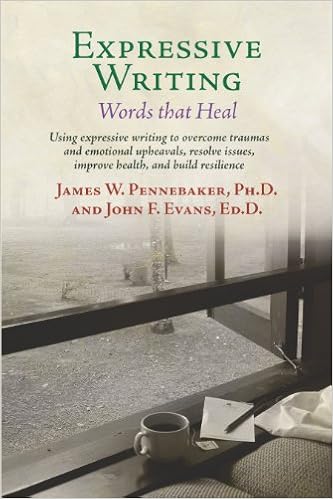
If you are interested in exploring this topic further, I recommend Expressive Writing: Words that Heal by James W. Pennebaker, PhD and John F. Evans, Ed.D.


Wednesday, July 29, 2015

Why Journal? (Tip/Reason #5)

Tip #5  - Take it out on your journal. It is the ideal place to vent your frustrations.

Sometimes one needs a place where they can safely express negative feelings. Rather than losing your cool at the office or with a loved one, which can easily escalate and lead to regret, retreat to your writing space at the first opportunity. There, lay it all out on the page or computer screen. I find venting is more effective when typing because I am better able to keep up with the thoughts racing through my head as opposed to handwriting them, which is considerably slower.

Allow all thoughts to appear on the page/screen. Do not censor them, just proceed with this task until you cannot, or do not, want to write any more. I guarantee you will feel a huge release from any pent-up negative energy. Do not read this entry immediately, if ever. Allow it to sit. Wait a few days if you do decide to review what you wrote. You can also choose to get rid of it. There are no rules.


If after a few days you are still stewing over whatever happened that incited your anger, take some time to read through the entry, if you still have it. Are there any solutions?  Do you feel the need for additional angry writing? If so, go at it. I repeat this exercise two more times if there is a situation over which I am obsessing.

However, if you fail to find peace or resolution, you may need to talk it out with the offending person. If you cannot directly speak with that person, perhaps a trusted friend or a professional can provide some guidance that will lead to relief.

Anger is stressful. I've found writing out my anger to be an effective way to not only alleviate it, but also to find solutions for dealing with whomever or whatever has upset me, or at least resolve to get over it. The next time you want to strike out at someone, take it out on your journal first.